
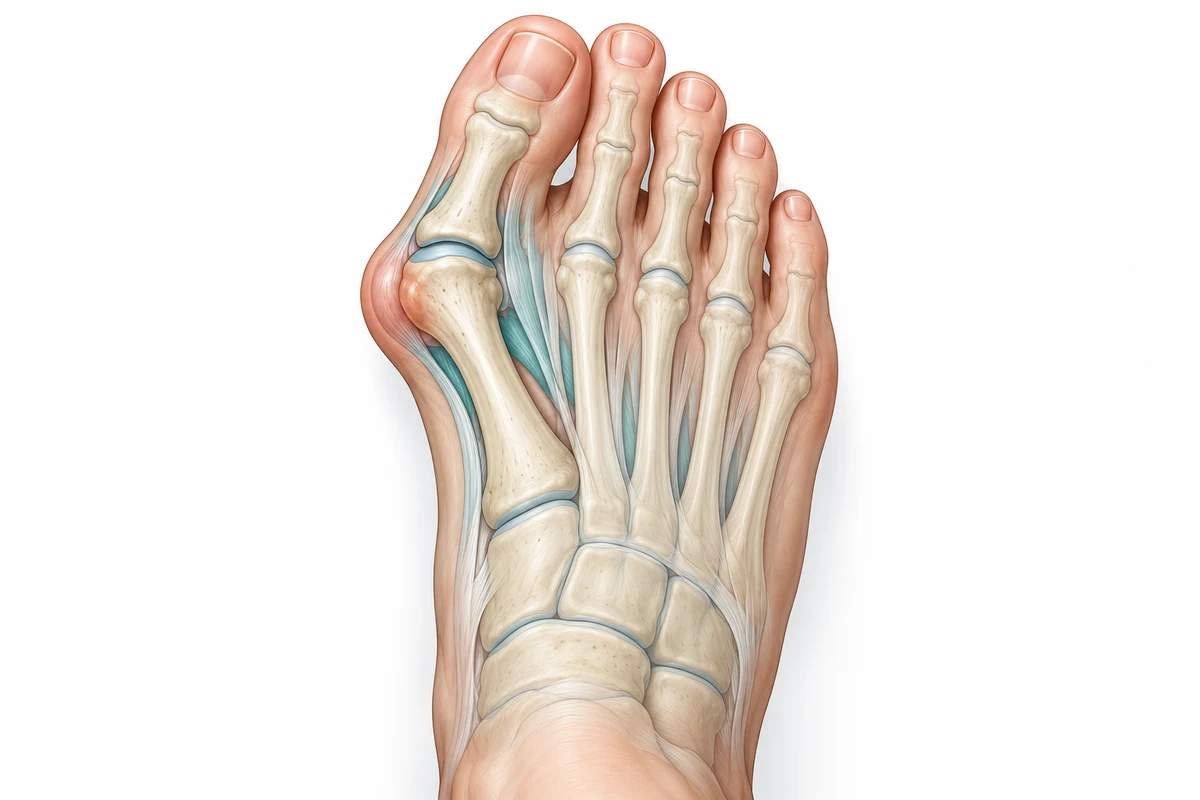
A bunion is an alignment problem.
The prominence beside the big toe is often the visible part of hallux valgus: the first metatarsal moves inward while the toe angles toward its neighbor. Shoes may rub the area, and walking can become uncomfortable. Correction addresses the position of the bones and joint, rather than simply shaving away a bump.1
Symptoms, joint movement and standing X-rays help explain the deformity. The size of a bunion alone does not tell you which treatment is right.
Choosing treatment starts with your symptoms.
Roomier footwear, padding and appropriate support may reduce pressure. They can improve comfort but do not reliably reverse an established bony deformity. Surgery becomes a consideration when pain and limitations continue despite nonsurgical care.1
Dr. Noman A. Siddiqui evaluates alignment, arthritis, previous surgery and the health of the surrounding foot. A smaller-incision osteotomy may suit some patients; others benefit from an open correction or a fusion. An osteotomy repositions bone while preserving the joint. A fusion joins the surfaces of a selected joint and is a different operation.
Circulation, sensation, diabetes control, smoking and the ability to protect the foot after surgery affect planning. Your assessment should produce a clear explanation of both the proposed procedure and its alternatives.
How minimally invasive correction works.
Through small access incisions, specialized instruments create a controlled cut in the first metatarsal. The bone is shifted into a new alignment, with X-ray imaging used during surgery to check the correction. Screws stabilize the position while the bone heals. A second small correction in the big-toe bone or a soft-tissue adjustment may be included when needed.5, 7
This is precise reconstructive surgery performed through limited openings. The cut, the amount of translation, rotational alignment and fixation all matter. Dr. Noman A. Siddiqui’s work on osteotomy position and screw placement addresses these technical decisions.5, 7
The incision pattern, anesthesia and time in the operating room depend on the surgical plan. Your care team will explain the expected schedule and whether additional procedures are proposed.
What smaller incisions can offer.
Limited soft-tissue exposure can support smaller scars and preservation of the tissues around the joint. Modern fixation can permit early protected walking in selected patients. These advantages are part of the approach described in Dr. Noman A. Siddiqui’s technique publications.1, 2
The goals are comfortable walking, improved alignment and better function. Scars, pain, swelling and recovery still vary. Smaller incisions do not make the procedure risk-free, and they do not guarantee a particular return-to-work or sports date.
A short-term comparison coauthored by Dr. Noman A. Siddiqui found comparable radiographic correction with chevron and minimally invasive distal metatarsal osteotomies.3 A separate retrospective study reported reduced forefoot width after MIS correction.6 These findings help explain alignment changes; they are not promises of a specific appearance or shoe size.
Laboratory work comparing two MIS osteotomy constructs found no statistically significant difference in the principal strength measures.4 This supports informed technique selection without claiming that one method is best for every foot.
Plan for the first days at home.
Bring your medication list, relevant medical history and prior imaging to the consultation. Discuss the activities that matter most to you, the footwear you need and the support available at home. The surgical team will give individualized instructions about medications, fasting and anesthesia.
- Arrange transport and help with daily tasks.
- Ask which shoe, boot or walking aid you will use.
- Plan time away from work around its physical demands.
- Confirm follow-up arrangements and whom to call with concerns.
Recovery progresses with healing.
Bone healing, incision healing and swelling determine progression. Early walking means protected walking under the surgical team’s instructions. Follow-up examinations and X-rays help decide when to change footwear and increase activity.
Immediately after surgery
A dressing and postoperative shoe protect the correction. Some patients are allowed to bear weight straight away. In the 2019 multicenter study, the reported protocol allowed immediate postoperative weight-bearing.2 Your permission depends on your operation and health.
The first few weeks
Follow-up focuses on the incision, swelling and protection. In the 2022 technique article, the authors described progression toward supportive athletic shoes at approximately two to four weeks when swelling and the incision allowed.8 This is a published protocol, not an automatic milestone.
Building everyday activity
Increase walking and change footwear only after clearance. Some patients need protected footwear longer. Elevation and a gradual increase in activity can help manage swelling, which may remain noticeable for months.
Returning to impact activity
The same technique article described considering impact activity at around ten to twelve weeks, subject to clinical and X-ray healing.8 Running, sport and demanding work require individualized clearance; comfortable everyday walking can return sooner than full recovery.
Ask about driving separately. The operated side, protective footwear and pain medication affect whether you can control a vehicle safely.
Discuss risks as well as benefits.
Potential problems include infection, nerve irritation or numbness, persistent pain, stiffness, delayed or incomplete bone healing, loss of correction and symptomatic screws. Some patients need an additional procedure. Anesthesia and blood-clot risks are also part of the preoperative discussion.
A bunion can recur after any technique. Recurrence depends on the original deformity, the correction, healing and time since surgery. A single percentage cannot describe every patient or every MIS procedure. Follow the protection and rehabilitation plan and keep scheduled reviews.
Contact the surgical team promptly if pain, redness, drainage or swelling is worsening unexpectedly. New calf pain, chest pain or shortness of breath needs urgent medical assessment.
Questions patients often ask.
Will I have screws, and are they removed later?
Modern MIS corrections commonly use screws. They generally remain in place after healing. Removal may be considered if hardware causes symptoms; it is not a routine requirement for everyone.7
Is this surgery painless or scar-free?
No operation can promise either. The incisions are smaller, but discomfort and visible scars are possible. Your team will explain pain control, wound care and what to expect from your own correction.
Can both feet be treated at the same time?
Bilateral surgery has been reported in Dr. Noman A. Siddiqui’s multicenter research.2 Whether to stage the procedures is a separate decision based on safe mobility, home support, your health and the protection each foot needs.
When can I wear normal shoes?
When healing and swelling permit. A supportive sneaker is usually a more realistic first step than a narrow dress shoe. The timeline discussed above is a guide to the decisions made at follow-up, not permission to change footwear yourself.
Does a severe bunion rule out minimally invasive surgery?
It does not answer the question by itself. Joint arthritis, rotation, instability and prior treatment also matter. Dr. Noman A. Siddiqui will explain whether an osteotomy, a fusion or another correction addresses your particular foot.
Will my bunion come back?
Recurrence is possible after any bunion surgery. Ask how your proposed correction addresses alignment and what long-term follow-up and footwear choices are appropriate for you.
What should I ask at my consultation?
Ask why the proposed procedure fits your X-rays, which alternatives exist, what risks matter for you, when you can walk and work, and how the team will assess healing before sports or driving.
The research behind the conversation.
These are publications authored or coauthored by Dr. Noman A. Siddiqui. The list distinguishes radiographic studies, laboratory research and a technique article: each answers a different question and none guarantees an individual result.
- Minimally Invasive Bunion Correction. (opens in a new tab)
Clin Podiatr Med Surg · 2018 · PMID 30223949
- Radiographic Outcomes of a Percutaneous, Reproducible Distal Metatarsal Osteotomy for Mild and Moderate Bunions: A Multicenter Study. (opens in a new tab)
J Foot Ankle Surg · 2019 · PMID 31679675
- Short-Term, Retrospective Radiographic Evaluation Comparing Pre- and Postoperative Measurements in the Chevron and Minimally Invasive Distal Metatarsal Osteotomy for Hallux Valgus Correction. (opens in a new tab)
J Foot Ankle Surg · 2021 · PMID 34090745
- Biomechanical Comparison of 2 Common Techniques of Minimally Invasive Hallux Valgus Correction. (opens in a new tab)
Foot Ankle Int · 2021 · PMID 33161779
- Radiographic and Cadaveric Analysis of Minimally Invasive Bunionectomy Osteotomy Position-"MIS Bunion Sweet Spot". (opens in a new tab)
Foot Ankle Spec · 2024 · PMID 35730534
- Retrospective Comparison of Preoperative and Postoperative Foot Width in Minimally Invasive Hallux Valgus Surgery. (opens in a new tab)
J Foot Ankle Surg · 2024 · PMID 37643686
- Angular position of proximal screw fixation during minimally invasive hallux valgus surgery in the sagittal plane. (opens in a new tab)
J Foot Ankle Surg · 2025 · PMID 40617555
- Siddiqui’s tips, tricks, and pearls for minimally invasive bunionectomy. (opens in a new tab)
Michael A. Thomas, Madison Ravine & Dr. Noman A. Siddiqui · Podiatry Today · 2022 · Technique and postoperative protocol.