What this means for patients
These conditions can affect foot shape, balance or stability, but they are different diagnoses. Evaluation identifies the source of the deformity, nerve and muscle function, skin health and the way the foot bears weight. A treatment plan is tailored to the diagnosis and may include protective footwear, bracing or reconstruction.
Charcot foot
Charcot neuroarthropathy can cause fractures, joint collapse and deformity in a foot with reduced sensation. Care considers protection and offloading, stability, skin breakdown and infection. Reconstruction and limb preservation may be discussed for selected patients.
Charcot–Marie–Tooth disease
Charcot–Marie–Tooth (CMT) is a group of inherited peripheral nerve disorders. Muscle weakness and imbalance can affect walking and contribute to high arches or toe deformities. Foot and ankle care addresses the resulting alignment and function, alongside neurological care.
Cavus and cavovarus foot
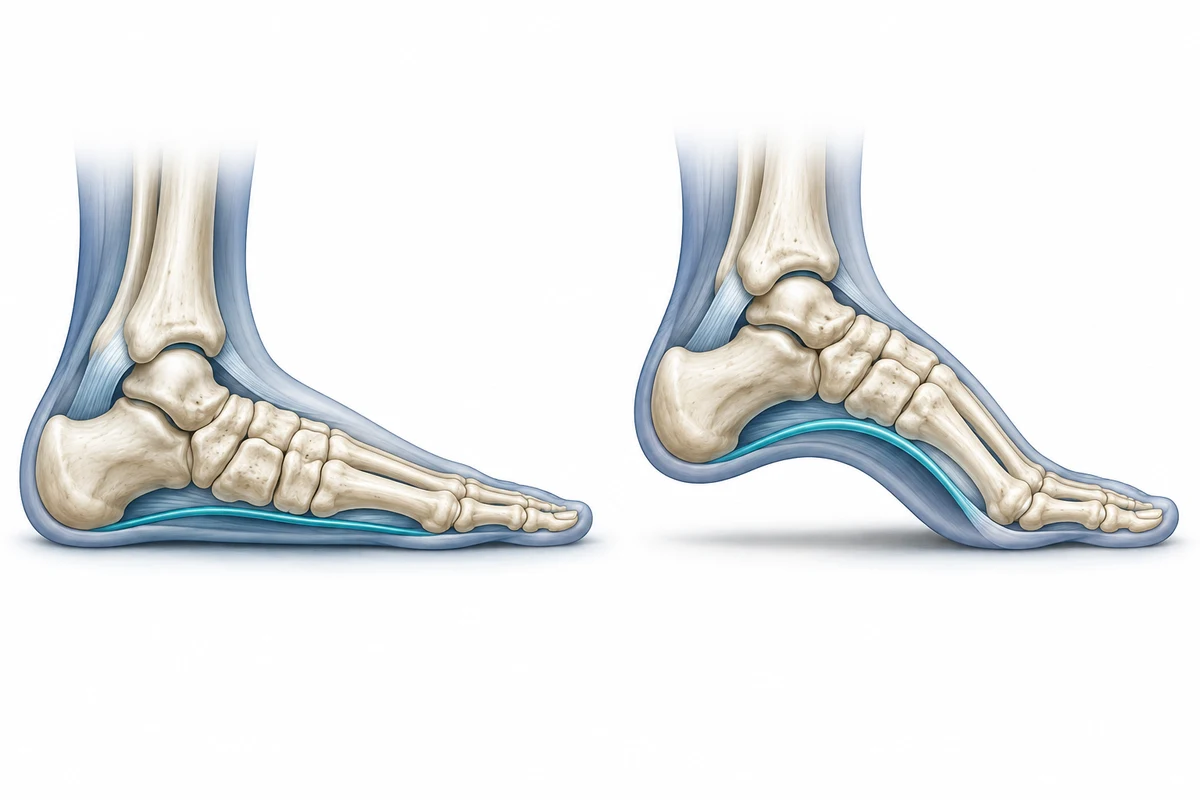
A cavus foot has a high arch; cavovarus describes a high arch with inward heel alignment. Assessment looks at flexibility, muscle balance, pain and ankle stability. A high arch does not by itself establish a diagnosis of CMT.
A warm, swollen foot needs timely assessment
In someone with reduced sensation, new warmth, redness or swelling can signal active Charcot neuroarthropathy even when pain is limited. Infection and other conditions can look similar. Prompt assessment is needed to identify the cause and prevent further joint damage; avoid relying on pain alone to judge severity.
Protecting the foot before reconstruction
Active Charcot care emphasizes reducing load and protecting the foot using a clinician-directed cast or boot. Later care may include specialist footwear or a brace. Marked instability, deformity or repeated skin breakdown can lead to a discussion of reconstruction after the disease stage and infection risk are assessed.
CMT and cavus require a different plan
An inherited nerve disorder can create weakness and muscle imbalance, while a high arch may also have other causes. Examine heel position, flexibility, toe shape and ankle stability. Bracing, tendon balancing and bone correction are considered according to the specific functional problem, alongside neurological care when appropriate.
Questions for your consultation
- Which diagnosis explains my foot shape or instability?
- What role do bracing and footwear have?
- What would reconstruction aim to improve?
Related published work
These citations cover related clinical themes; each original article defines its own scope.
Educational summaries are not individualized medical advice.
Research & surgical education
Dr. Noman A. Siddiqui’s scholarship includes journal articles, book chapters and professional technique publications in foot and ankle surgery.